Energy Storage Systems for EVs: Technologies, Challenges, and Pathways toward Transportation Decarbonization
DOI:
https://doi.org/10.65998/ljsdr.v2i1.11Keywords:
Energy Storage Systems, Electric Vehicles, Hybrid Energy Storage, Power Electronics Integration, Transportation DecarbonizationAbstract
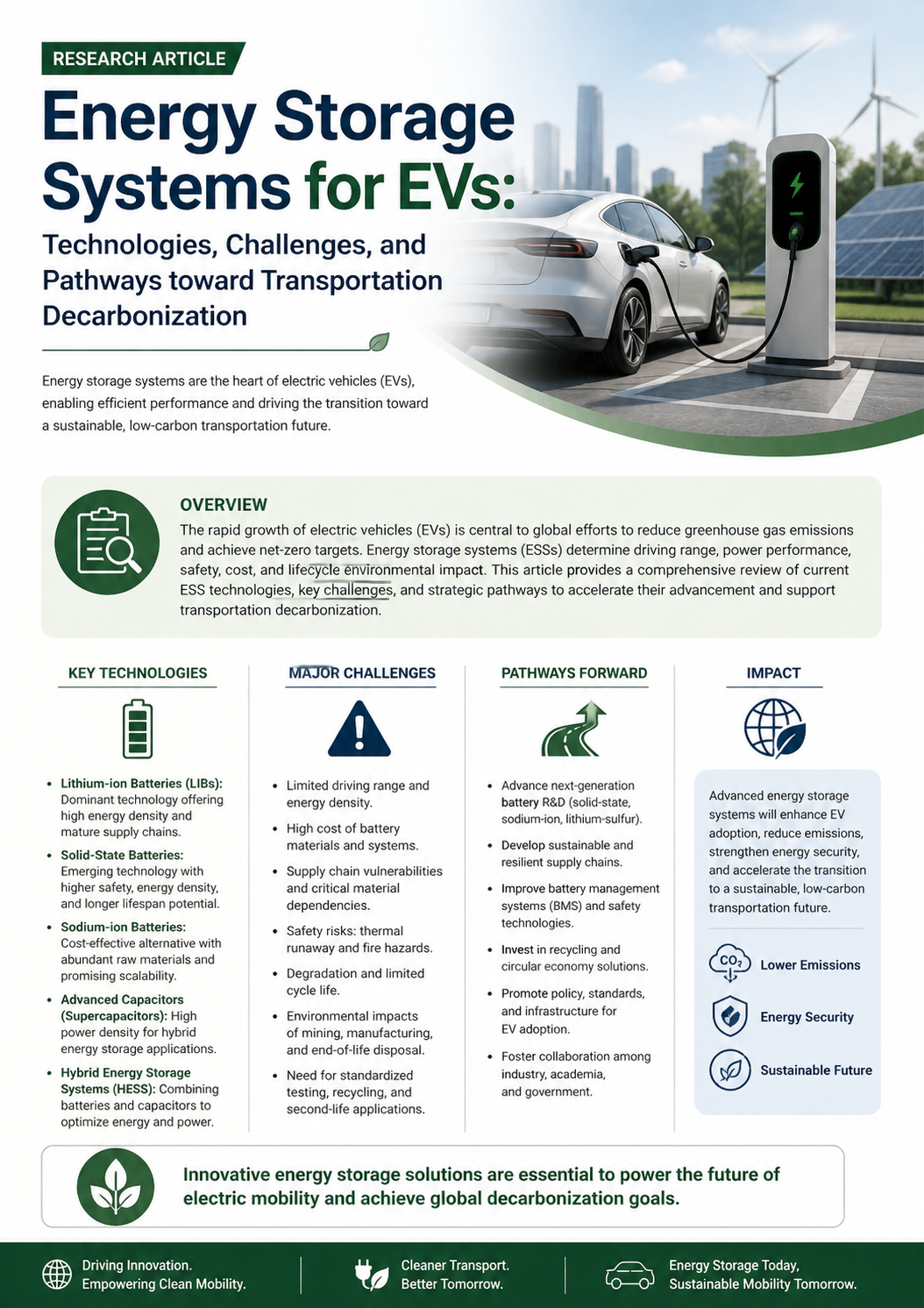
Energy storage systems (ESSs) are the technological foundation of electric vehicles (EVs) and a critical enabler of transport-sector decarbonization. This paper synthesizes key findings from a comprehensive review of ESS technologies for EV applications through five integrated perspectives: (i) the role of ESSs in reducing CO₂ emissions via electrified propulsion, regenerative braking, and compatibility with low-carbon electricity systems; (ii) comparative performance assessment of major storage options, including lithium-ion batteries, fuel cells, ultracapacitors, and emerging alternatives, across energy/power density, efficiency, lifecycle durability, safety, and cost; (iii) identification of prevailing technical and sustainability constraints, notably safety risks, thermal management demands, degradation mechanisms, charging limitations, packaging challenges, and lifecycle environmental impacts related to manufacturing and end-of-life treatment; (iv) evaluation of hybrid energy storage systems and the enabling function of advanced power electronics and control strategies in optimizing energy flow, improving efficiency, and extending component lifetime; and (v) articulation of future research and policy priorities required for next-generation ESS development. The review concludes that no single storage technology optimally satisfies all EV requirements, reinforcing the importance of application-specific selection and hybrid architectures. Continued progress in materials innovation, intelligent battery management, fast-charging and grid co-optimization, circular-economy pathways, and harmonized standards and policies is essential to deliver cost-effective, safe, long-lifetime ESSs that can support large-scale EV deployment and durable decarbonization outcomes.
Downloads
Downloads
Published
Issue
Section
License
Copyright (c) 2026 Libyan Journal of Sustainable Development Research

This work is licensed under a Creative Commons Attribution 4.0 International License.