Recent Trends, Challenges, and Future Prospects of Battery Technologies and Battery Management Systems for EVs
DOI:
https://doi.org/10.65998/ljsdr.v2i1.13Keywords:
Electric vehicles, Battery technologies, Battery management systems, State estimation, Intelligent energy storageAbstract
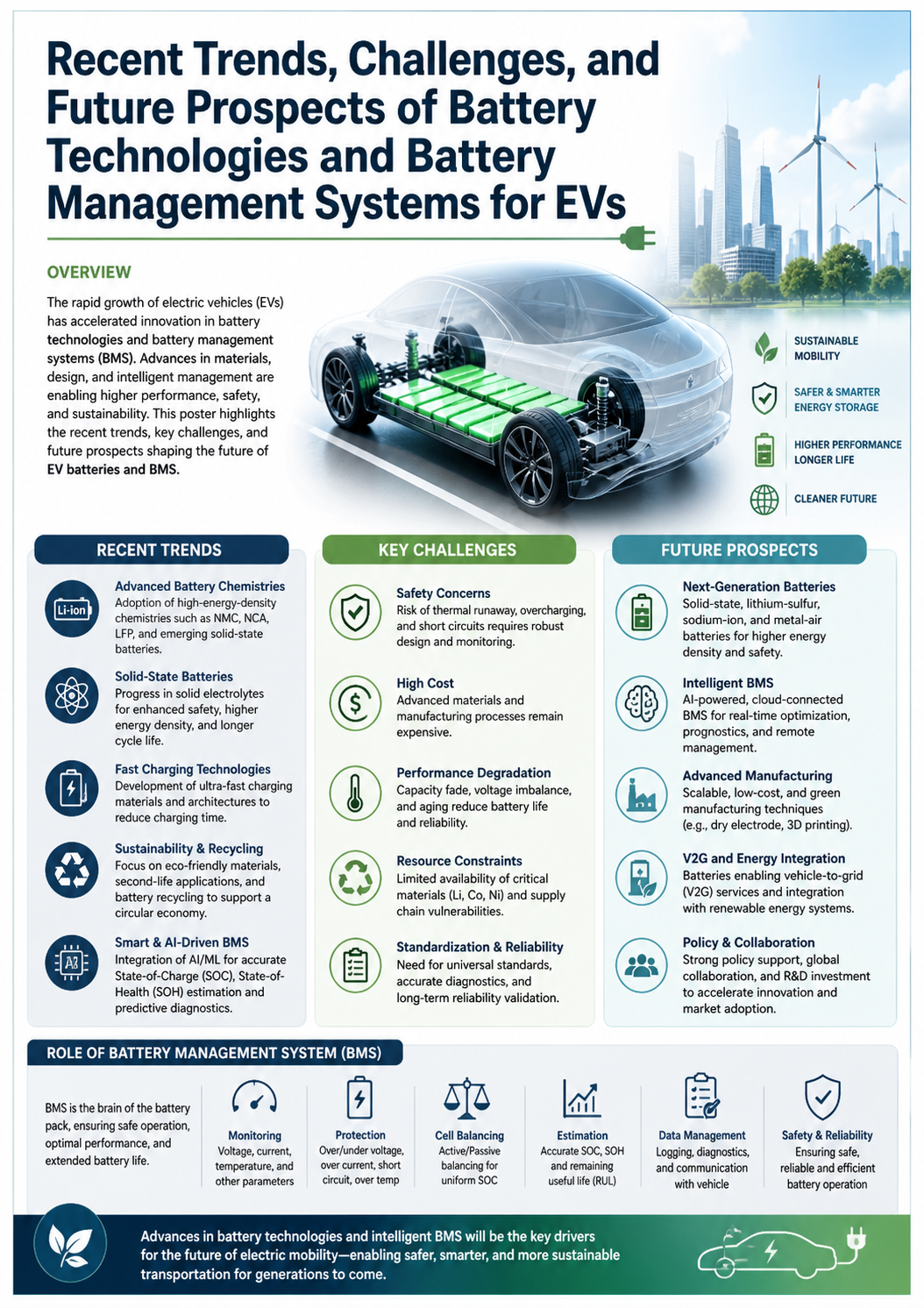
This article presents a comprehensive invistigation of battery technologies and battery management system (BMS) functionality for electric vehicles (EVs), synthesizing the current status, key challenges, and future perspectives. The study highlights that lithium-ion chemistries, particularly NMC, LFP, and NCA, remain the dominant solutions due to their technological maturity and balanced trade-offs among energy density, power capability, cycle life, safety, and cost. Emerging alternatives, including solid-state, lithium–sulfur, and sodium-ion batteries, are examined as prospective pathways to enhance safety, sustainability, and resource security, although they face limitations in readiness level, durability, and scalable integration. The article further analyzes the functional architecture of BMS, emphasizing critical subsystems for sensing and data acquisition, state estimation (SOC, SOH, SOP), cell balancing, and thermal coordination. It demonstrates a transition from classical model-based approaches toward hybrid and data-driven methods, including adaptive observers and machine-learning-assisted estimation, to improve robustness under aging and uncertain operating conditions. Key challenges identified include electrochemical degradation, thermal runaway risk, fast-charging stress, sensor drift, model uncertainty, cybersecurity vulnerabilities, and system-level issues related to high-voltage architectures, pack scalability, and vehicle-to-grid compatibility. Finally, future directions are outlined, focusing on next-generation materials, ultra-fast-charging-compatible designs, intelligent connected BMS platforms, digital twins, cloud diagnostics, and predictive health management. The article concludes that battery–BMS co-design, aligned with safety standards and lifecycle sustainability, is essential to enable next-generation electric mobility and accelerate transportation decarbonization.
Downloads
Downloads
Published
Issue
Section
License
Copyright (c) 2026 Libyan Journal of Sustainable Development Research

This work is licensed under a Creative Commons Attribution 4.0 International License.