A Geological Screening Framework for Underground Green Hydrogen Storage in Libya: Basin-Scale Evaluation and Site Prioritization
DOI:
https://doi.org/10.65998/ljsdr.v2i2.23Keywords:
Green Hydrogen, Underground Storage, Geology, Libya, Energy TransitionAbstract
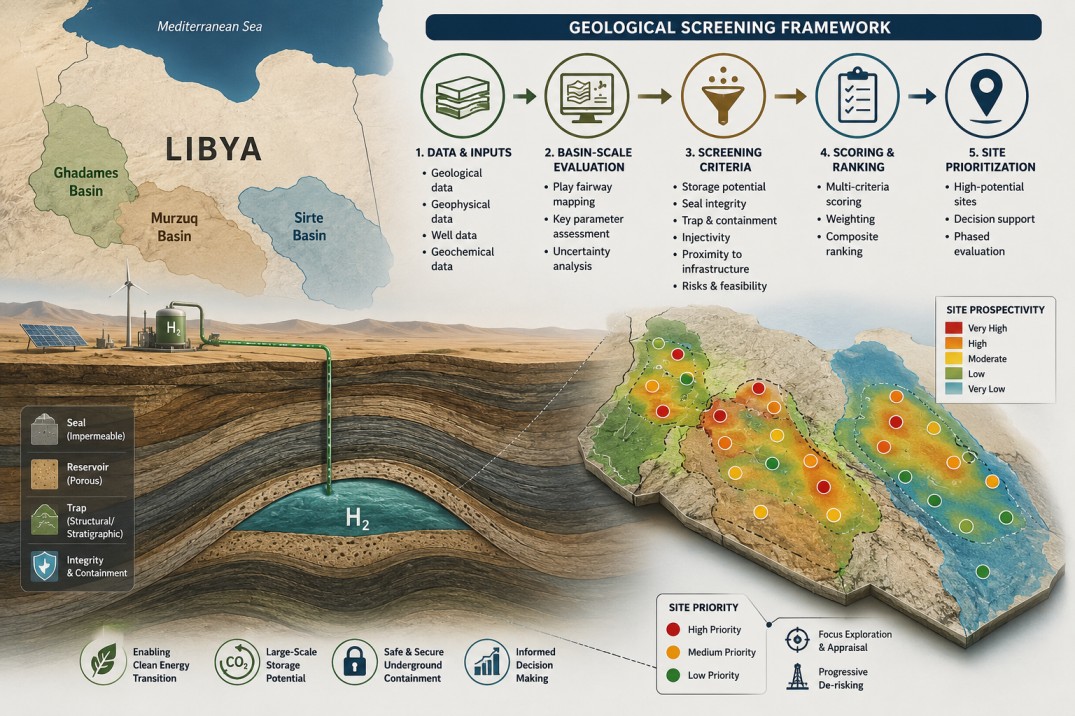
The global transition toward low-carbon energy systems has intensified the demand for large-scale, safe, and cost-effective hydrogen storage solutions to support renewable energy integration. Libya possesses significant solar and wind resources, along with extensive sedimentary basins; however, its potential for underground hydrogen storage (UHS) remains insufficiently explored. This study presents a comprehensive geological evaluation and comparative assessment of Libya’s major sedimentary basins the Sirte, Ghadames, and Murzuq basins with a focus on depleted hydrocarbon reservoirs as the most feasible storage option. Salt caverns, widely regarded as optimal for hydrogen storage, are not viable in Libya due to the absence of sufficiently thick and laterally continuous salt formations. Instead, mature and over-mature fields particularly sandstone and carbonate formations offer a practical. These reservoirs exhibit favorable petrophysical properties, including porosity ranging from 15% to 30% and permeability exceeding 100 mD, along with effective regional caprocks such as evaporites and shale sequences. To support systematic site selection, a screening framework is applied that integrates reservoir quality, caprock integrity, structural stability, and infrastructure availability, enabling risk-informed ranking of candidate sites. Results indicate that the Sirte Basin represents the most suitable candidate for Phase 1 pilot implementation and commercial-scale deployment due to its abundance of mature and depleted reservoirs, large storage capacity, extensive infrastructure, and proximity to major export terminals. The Ghadames Basin emerges as a viable secondary option, while the Murzuq Basin remains a longer-term prospect. Overall, Libya demonstrates strong geological potential for UHS; however, further site-specific investigations are required to ensure long-term storage integrity and operational feasibility. Key priorities include infrastructure integrity assessments, targeted geochemical analyses, the development of a national regulatory framework, and the expansion of the UHSSI into a nationwide storage mapping tool.
Downloads
Downloads
Published
Issue
Section
License
Copyright (c) 2026 Libyan Journal of Sustainable Development Research

This work is licensed under a Creative Commons Attribution 4.0 International License.